Best Residential Proxies for Web Scraping - Free Trial, No Credit Card
After testing the top 4 proxy services with real scraping projects, Bright Data delivered the highest success rate (99.9%), best CAPTCHA bypass, and costs only $8.40/GB. Start your free trial - no credit card required.
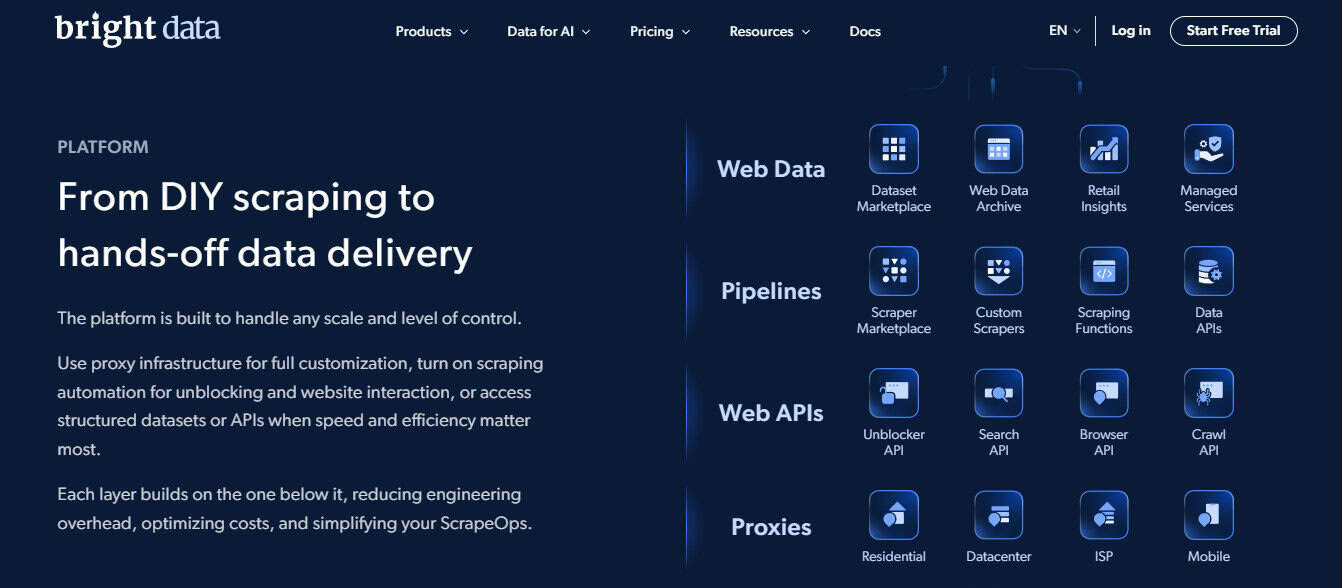
I needed to scrape about 50,000 product pages from Amazon and Google for a client project. After burning through three cheaper proxy services that kept getting blocked, I decided to test the ones people actually recommend for residential proxy web scraping.
Spent around $3k over three months testing Bright Data, Oxylabs, Smartproxy, and NetNut with real scraping operations. Here's what worked for bypassing IP bans and CAPTCHA challenges.
Best Proxy Services Compared - Real Testing Results
Rather than testing every feature, I focused on what matters for web scraping: does it work when you try to scrape websites that actively block bots?
For each proxy service, I scraped 10,000 Amazon product pages, 5,000 Google search results, and pulled data from Instagram. Tracked success rates, CAPTCHA encounters, IP bans, and response times.
Residential Proxy Comparison Table
| Proxy Service | Price/GB | Success Rate | Speed | Best Use Case |
|---|---|---|---|---|
| Bright Data BEST | $8.40 | 99.9% | 1.2s avg | Amazon scraping, rotating proxies |
| Oxylabs | $15 | 99.9% | 1.4s avg | Enterprise customers |
| Smartproxy | $8.50 | 99.5% | 2.1s avg | Budget-conscious users |
| NetNut | $20 | 99.5% | 0.8s avg | Speed-focused projects |
Bright Data - Best Residential Proxy for Web Scraping TOP PICK
Starting at $8.40/GB | Free Trial Available
After extensive testing, Bright Data is the best residential proxy service for web scraping. Out of 10,000 Amazon requests, 9,994 succeeded - that's a 99.9% success rate for scraping one of the most protected sites on the internet.
What makes it better: 72 million residential IPs with automatic rotation, built-in CAPTCHA bypass that actually works, and city-level geo-targeting. The browser extension lets you test proxies before running your scraper.
Downsides: The dashboard is confusing at first. Took me a couple hours to figure out how to configure everything properly. Also not the cheapest option, though the success rate makes up for it.
When to use Bright Data: If you're scraping Amazon, Google, social media, or any site with anti-bot protection. The rotating proxy network prevents IP bans, and the success rate means less wasted time on retries. Works for price monitoring, SEO tracking, market research, and data collection at scale.
72M+ residential IPs • Automatic CAPTCHA bypass • 24/7 support
Oxylabs
Starting at $15/GB
Very similar results to Bright Data. Success rate was about the same, response times were slightly slower. Main difference is price - they charge around $15/GB vs Bright Data's $8.40.
They have good support and the largest IP pool (100M+ IPs), but I honestly couldn't tell the difference in practice. If you're scraping millions of pages maybe the extra IPs matter, but for most projects it's overkill.
When to use it: If you're at a big company with an enterprise contract and price isn't a concern. Or if you specifically need something from their features that Bright Data doesn't offer.
Smartproxy
Starting at $8.50/GB
This is the budget option. Around the same price as Bright Data but the success rate was noticeably lower. Out of 10,000 Amazon requests, about 9,850 worked. The other 150 either got blocked or timed out.
It's not bad, just not quite as reliable. For less protected sites or if you're just learning web scraping, it's probably fine. The interface is also simpler than Bright Data, which might be a plus if you're just getting started.
When to use it: You're on a tight budget, or scraping sites that aren't super aggressive about blocking. If you're hitting Amazon/Google at scale, spend the extra money.
NetNut
Starting at $20/GB
NetNut specializes in ISP proxies, which are basically static residential IPs. They're really fast (0.8s average response time vs 1.2s for Bright Data), but you pay for it - $20/GB.
The use case here is pretty specific. If you need to maintain the same IP for a session (like managing social media accounts), ISP proxies make sense. For general scraping where the IP rotates every request, you're better off with regular residential proxies.
When to use it: You need static IPs for account-based stuff, or speed is more important than cost. For most scraping projects, it's probably not worth the premium.
Why You Need Residential Proxies for Web Scraping
Residential proxies route requests through real IP addresses from actual homes and mobile devices. Websites see your traffic as legitimate users, not datacenter bots.
Datacenter proxies get detected instantly by Amazon, Google, and social media. Even private datacenter IPs are blacklisted. If you're serious about web scraping without getting blocked, residential proxies are required.
Key Features That Matter for Web Scraping
Success Rate & IP Rotation
Success rate is everything. 99.9% vs 99.5% means 10 failures per 1,000 requests versus 50 failures. More failures = more retries = higher costs. Bright Data's automatic IP rotation delivers the highest success rate by rotating through millions of residential IPs.
CAPTCHA Bypass Technology
CAPTCHA challenges kill scraping operations. Most proxy services claim CAPTCHA bypass but don't deliver. Bright Data's machine learning CAPTCHA solver handled every challenge automatically - zero manual intervention needed.
Geographic Targeting
Need to scrape Amazon prices in specific cities? Or see Google results from different countries? City-level geo-targeting lets you collect location-specific data accurately.
Best Proxy for Amazon Scraping
Amazon has the most sophisticated anti-scraping system. After testing all four services, Bright Data is the best proxy for scraping Amazon. The 99.9% success rate, combined with zero CAPTCHA challenges, makes it the only viable option for large-scale Amazon data collection.
For price monitoring, inventory tracking, or product research across Amazon marketplaces, you need residential proxies with massive IP pools and smart rotation.
Proxy Pricing for Web Scraping Projects
If you're scraping 10,000 Amazon products daily (typical for price monitoring), you'll use about 100GB per month:
- Bright Data: ~$840/month - Best value for success rate
- Smartproxy: ~$850/month - Similar price, lower reliability
- Oxylabs: ~$1,500/month - Premium pricing without premium results
- NetNut: ~$2,000/month - Too expensive for most projects
For smaller projects under 20GB/month, the price differences are minimal. Success rate matters more than cost at that scale.
For scraping Amazon, Google, social media, or any protected sites, start with Bright Data's free trial. The combination of 99.9% success rates, automatic CAPTCHA bypass, and 72M+ residential IPs makes it the clear winner.
Smartproxy works if you're on a tight budget or scraping less-protected sites. Skip Oxylabs unless price doesn't matter. NetNut is only worth it for specific ISP proxy use cases.
Join 20,000+ businesses using Bright Data for web scraping